“Every major life transition carries within it both an ending and a beginning. The work is not to skip the ending — it is to learn how to grieve it well enough to walk toward what comes next.”
There is a particular kind of disorientation that comes with a major life transition — one that is difficult to describe until you are in the middle of it. You may look around at your life and recognize everything in it, yet feel somehow like a stranger inside it. Or you may find that the life you knew has genuinely changed beyond recognition — through divorce, loss, the departure of your children, a career upheaval, or a reinvention you chose but didn’t fully anticipate.
Whatever brought you here, I want you to know something important: what you are experiencing is not weakness. It is not dysfunction. It is the entirely predictable, profoundly human response to change — and you are far from alone in feeling it.
As a licensed psychotherapist with over 20 years in private practice, I have sat with women navigating virtually every kind of major life transition. Divorce. Widowhood. Empty nesting. Career collapse and reinvention. Loss of health, loss of identity, loss of a future they had counted on. What I have learned, again and again, is that the experience of transition is both deeply personal and strikingly universal. And that the women who move through it most fully are not the ones who feel the least — they are the ones who learn to feel, and understand, and respond to what they feel with intention.
This post is the foundation of our Life Transitions series — a place to begin before we go deeper into each specific kind of transition in the posts that follow. Here I want to give you a framework: a way of understanding what major life transitions actually are, what they do to us psychologically, and what the research and clinical experience tell us about moving through them with more grace, more support, and more of yourself intact.
“Transition is not a problem to be solved. It is a passage to be navigated — with the right map, the right companions, and the courage to keep walking even when you cannot yet see where the path leads.”
What Is a Life Transition, Really?
The word “transition” is used so frequently that it has almost lost its weight. But in psychological terms, a major life transition is something specific and significant: it is an event or period that fundamentally disrupts our sense of who we are, how we relate to others, and what we expect from the future.
Psychologist William Bridges, whose seminal work on transitions has informed decades of therapeutic practice, made an important distinction between a change and a transition. A change is an external event — the divorce is finalized, the last child moves out, the job ends. A transition is the internal psychological process that follows. The change can happen in a day. The transition can take years.
Bridges described three phases of every transition: an ending (letting go of what was), a neutral zone (the disorienting in-between space), and a new beginning (the gradual emergence of something new). Most of us want to skip straight from the ending to the new beginning — to feel better as quickly as possible. But the neutral zone, uncomfortable as it is, is where the real work of transformation happens. You cannot rush it. You can only move through it with more or less support, more or less awareness.
✦ A Note on the Neutral Zone
The neutral zone — that disorienting in-between space — is often when people seek therapy, reach for alcohol or other numbing strategies, rush into new relationships, or make major decisions they later regret. If you are in this space right now, the single most important thing is this: slow down. What feels unbearable in the neutral zone rarely requires immediate action. It requires presence, support, and time.
The Six Most Common Major Life Transitions
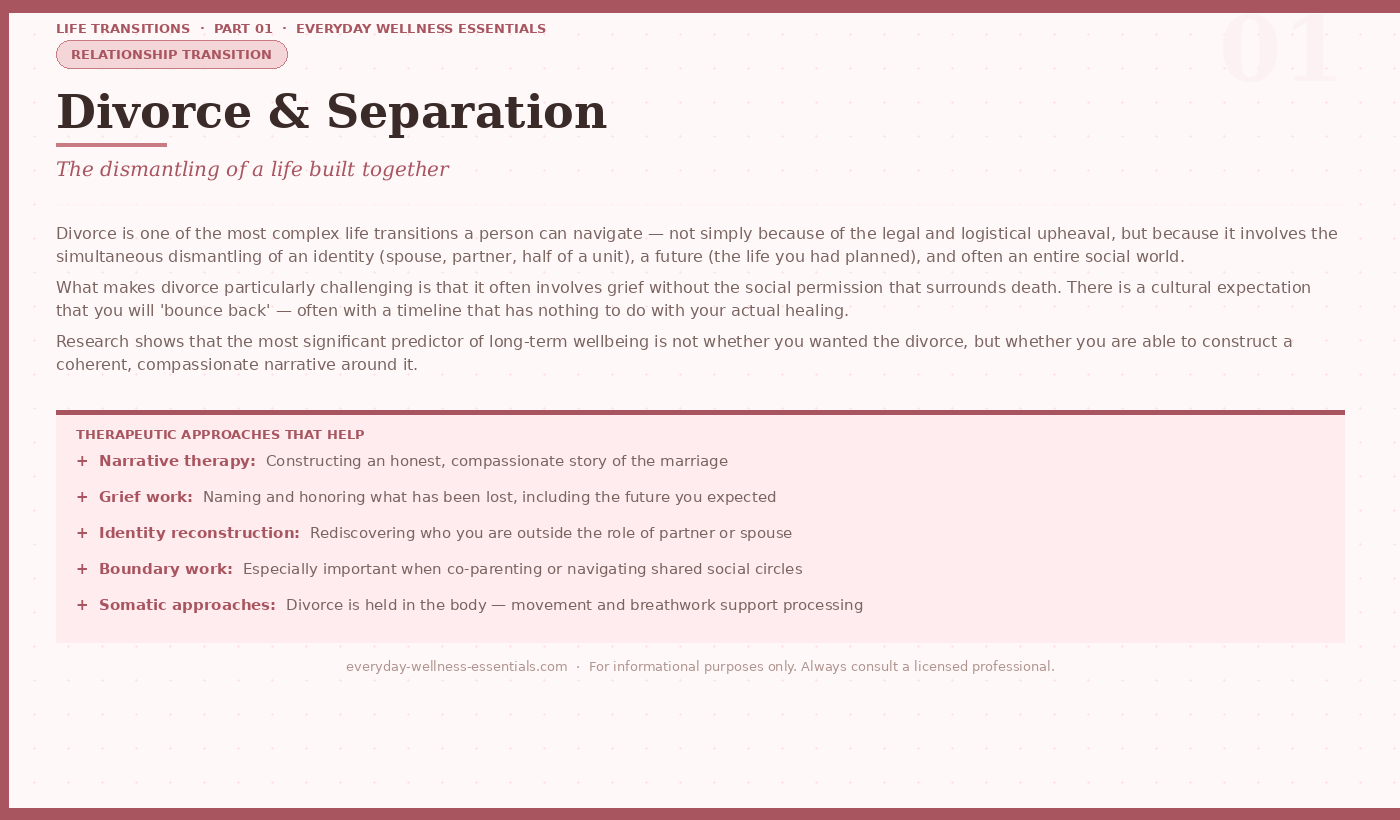
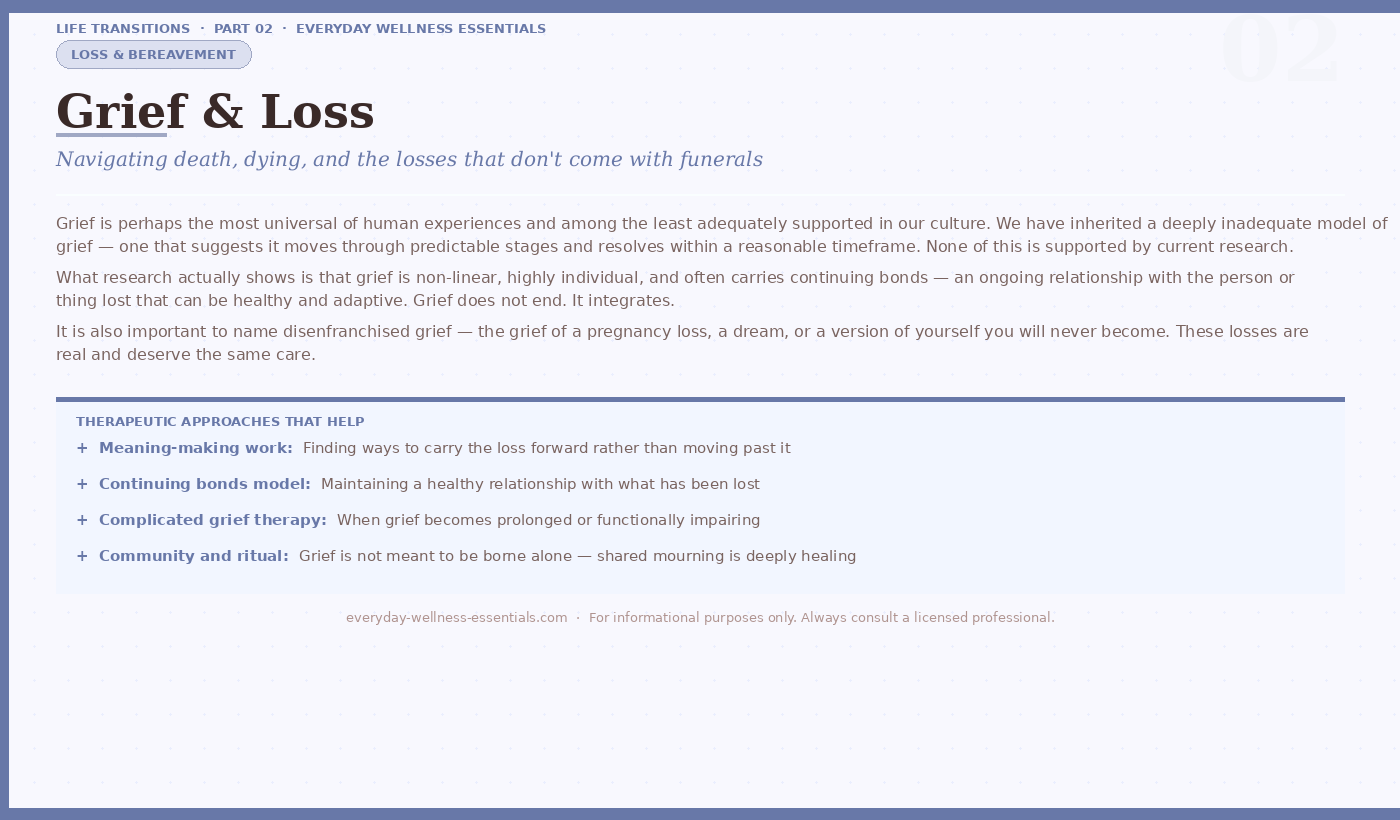
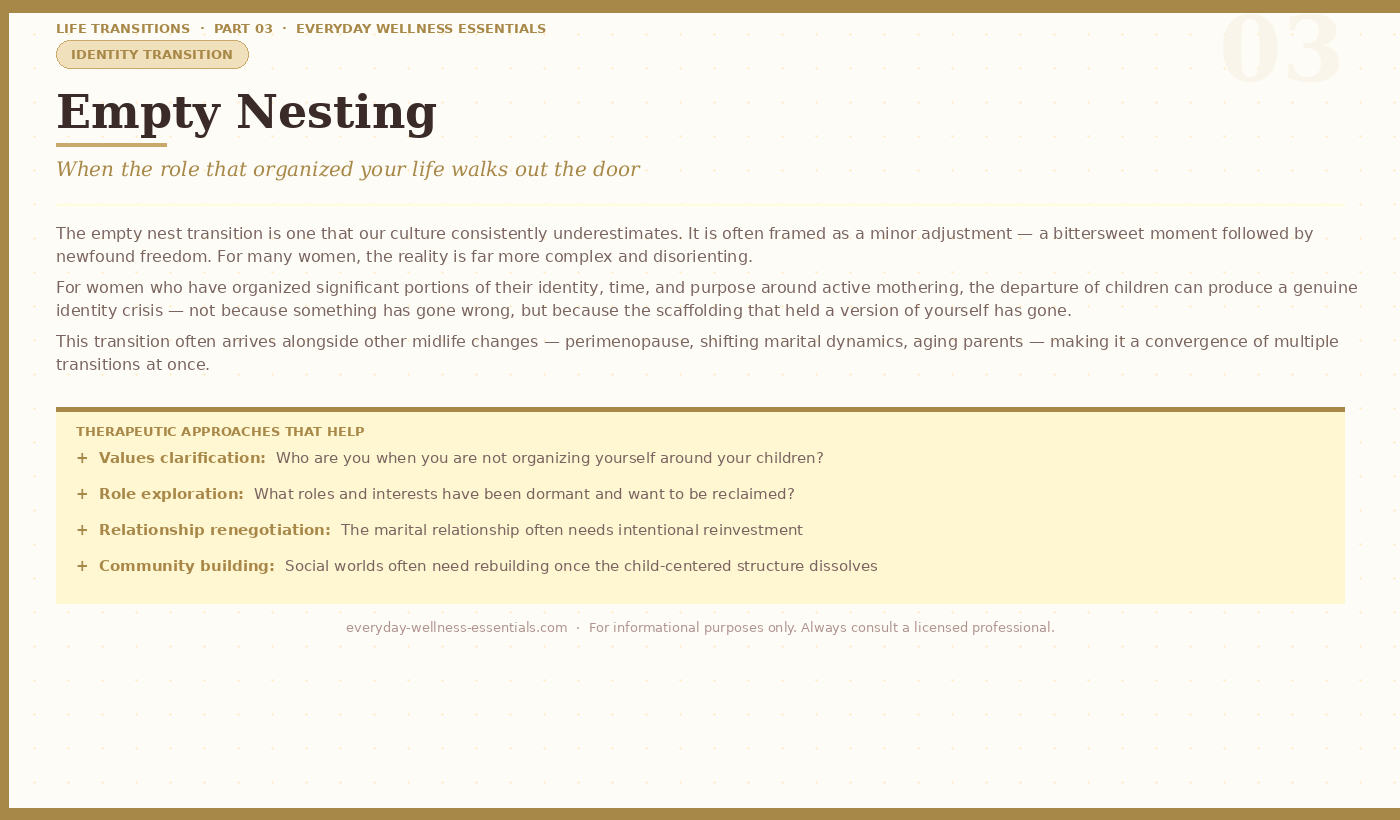
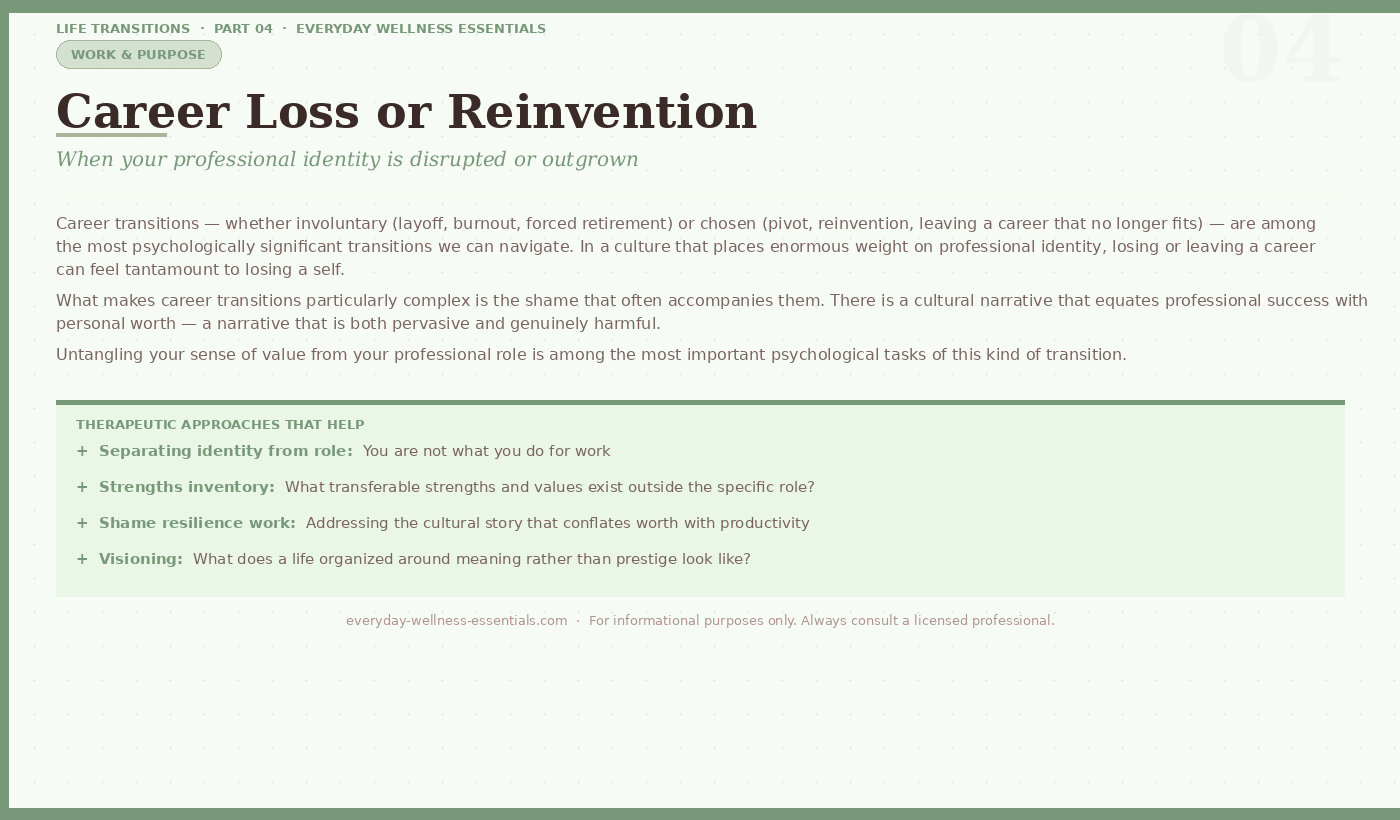
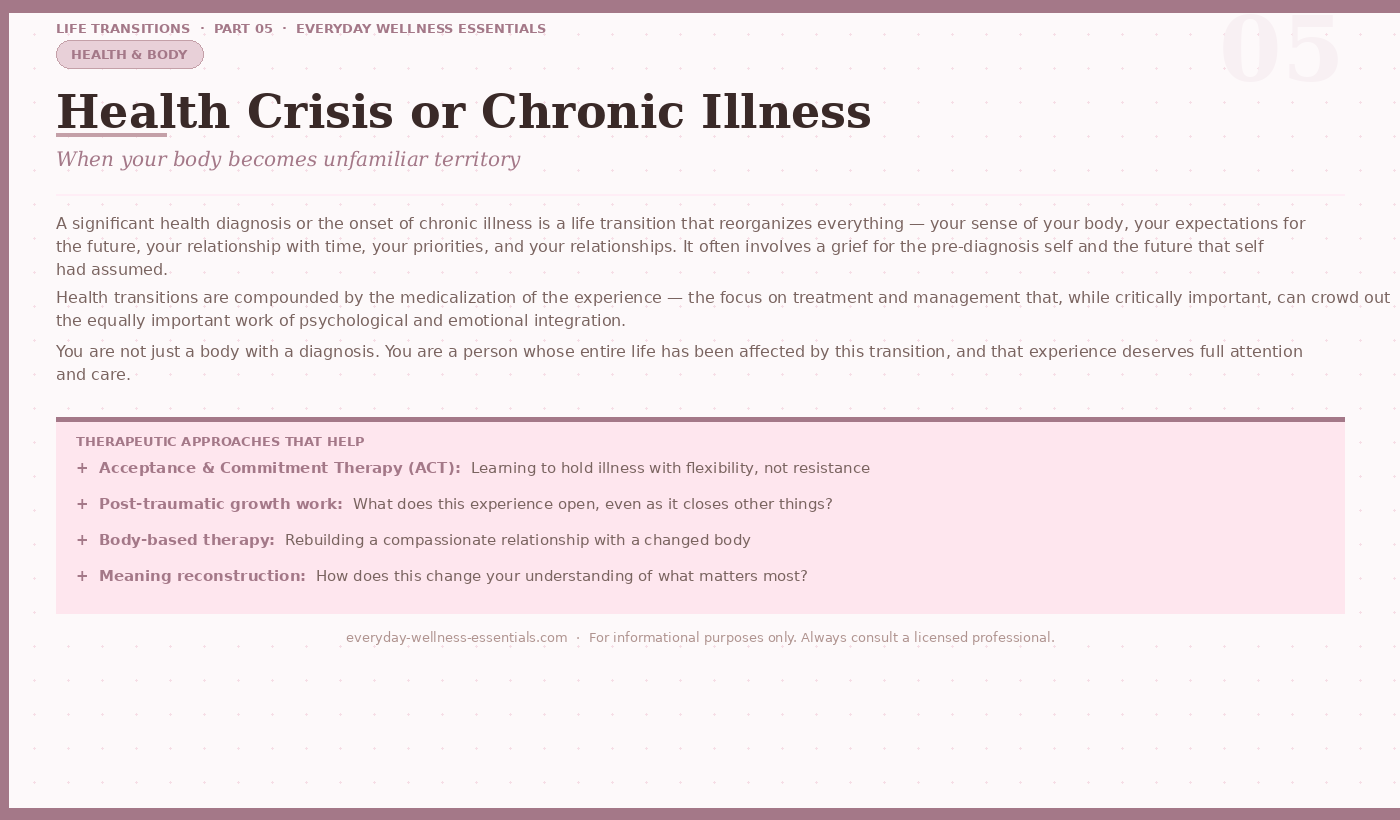
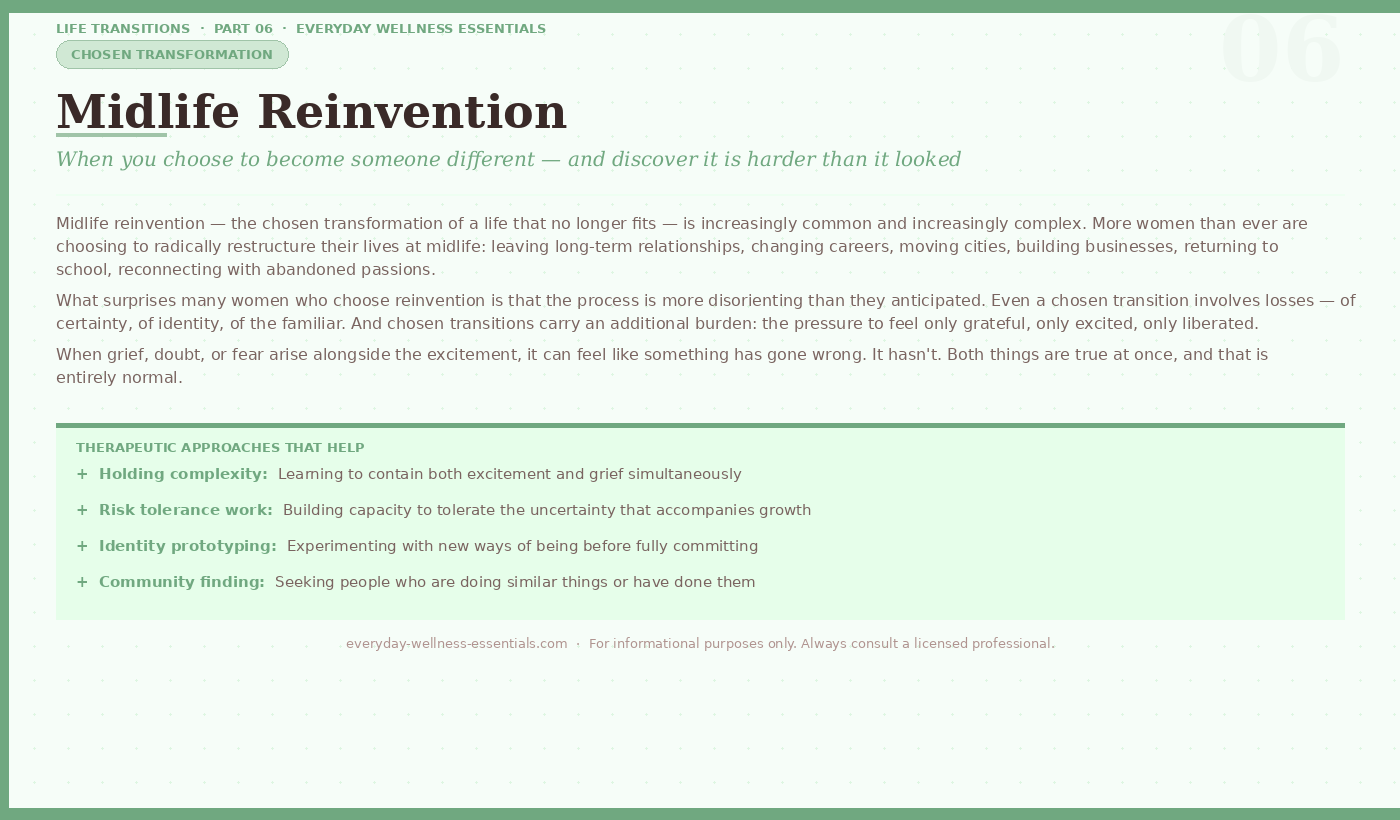
While every transition is unique, certain types appear again and again in clinical practice — and each carries its own particular psychological terrain. Here are the six most common ones I work with, along with the specific challenges they tend to bring and the therapeutic approaches I find most helpful for each.
A Framework for Moving Through Any Transition
While every transition is different, the psychological work of moving through them has common elements. Here is the framework I return to again and again in my clinical work — seven steps that apply regardless of the specific nature of the transition you are navigating.
1. Name what is actually happening
Transition, by definition, involves both an ending and a beginning. Before you can move forward, you need to clearly identify what is ending — not just the external change, but the internal one. What role, identity, relationship, future, or version of yourself is being lost? Naming it precisely is the beginning of being able to grieve it.
2. Give Yourself Permission to Grieve
Every transition involves loss, even chosen and welcome ones. Grief is not a sign that you made the wrong decision or that you are not resilient enough. It is the appropriate response to the ending of something real. Suppressing it does not make it disappear — it makes it take longer and cost more.
3. Slow Down in the Neutral Zone
The in-between space — after the ending and before the new beginning is clear — is deeply uncomfortable. Our instinct is to escape it as quickly as possible. But the neutral zone is where integration happens. Where identity is reformed. Where new values clarify themselves. Slow down. Stay curious. Resist the urge to make permanent decisions from temporary feelings.
4. Regulate Your Nervous System Daily
Major transitions are physiologically activating. Cortisol rises. Sleep disrupts. The nervous system operates in a near-constant state of low-grade threat response. Daily nervous system regulation — breathwork, movement, rest, nature, connection — is not optional during a major transition. It is foundational to everything else.
5. Seek Support Deliberately
Isolation amplifies the difficulty of every transition. Human beings are not designed to navigate major change alone. Therapy, support groups, trusted friends, mentors, coaches — some combination of structured support is not a luxury during a major transition. It is how we get through without losing ourselves in the process.
6. Tend to Your Identity
Ask yourself regularly: What do I know to be true about who I am, regardless of what is changing around me? What values, qualities, and ways of being belong to me — not to my role, my relationship, or my circumstances? Anchoring to your core identity provides stability while the outer structures of your life are in flux.
7. Orient Toward Meaning, Not Just Recovery
The goal of navigating a major transition is not to return to how you felt before — it is to integrate the experience and emerge with a richer, more authentic relationship to your own life. Research on post-traumatic growth consistently shows that people who actively seek meaning in their experiences — who ask “what does this make possible?” alongside “why did this happen?” — fare significantly better long-term.
“You are not trying to get back to who you were before. That person lived through something that changed her. You are trying to discover who she is becoming.”
When to Seek Professional Support
Navigating a major life transition with the support of a licensed therapist is not a sign of fragility — it is one of the most effective things you can do for your long-term wellbeing. That said, there are particular signs that suggest professional support is not just helpful but genuinely important:
Persistent low mood, hopelessness, or loss of interest in things that usually bring pleasure lasting more than two weeks
Significant disruption to sleep, appetite, or daily functioning
Increasing use of alcohol, substances, or other numbing behaviors
Thoughts of self-harm or suicide — please reach out immediately if this is your experience
Feeling stuck in the same painful thoughts or feelings without movement over several months
Significant relationship deterioration that has not responded to your own efforts
If you are in Michigan and would like to explore working together, I welcome you to inquire about my private practice. If you are outside Michigan, thePsychology Today therapist directory is an excellent resource for finding a licensed therapist near you.
Books & Tools That Support the Journey
These are among the resources I most frequently recommend to clients and readers navigating major life transitions. All product links are affiliate links — I only share what I genuinely believe in.
📚 ESSENTIAL READING:
Transitions: Making Sense of Life’s Changes — William Bridges
The foundational book on life transitions, now in a fully revised edition. Bridges’s model of endings, the neutral zone, and new beginnings is the most clinically useful framework for understanding transition I have encountered in 15 years of practice. Required reading for anyone in the middle of major change.
Option B: Facing Adversity, Building Resilience — Sheryl Sandberg & Adam Grant
A profoundly honest and research-grounded exploration of how we build resilience in the face of life’s hardest transitions. Sandberg’s personal experience of sudden loss combined with Grant’s research expertise makes this one of the most accessible and genuinely useful books on navigating major adversity.
📓 JOURNALING & REFLECTION:
Journal for Women – Guided Mindfulness Journaling Notebook
A beautiful, structured journaling companion for navigating major life change. Includes prompts for grief work, identity exploration, values clarification, and visioning the next chapter. One of the most practically useful tools I recommend for the neutral zone.
🧘 MIND-BODY SUPPORT:
Meditation Cushion & Mindfulness Starter Set
A daily mindfulness or meditation practice is one of the most evidence-based tools for navigating the heightened emotional activation of major transition. Creating a beautiful, dedicated space for this practice supports consistency.
Red Light Therapy Panel
Designed for convenient at-home sessions as part of a daily wellness routine. Many people incorporate red light sessions into routines focused on relaxation and healing of the mind and body. Red light therapy (RLT) helps manage grief and depression by stimulating mitochondrial energy production in brain cells, which enhances serotonin and dopamine production. It reduces neuroinflammation, improves sleep by regulating melatonin, and increases cellular energy to improve mood and resilience. This non-invasive approach aids in relieving emotional overwhelm and promoting a calmer mental state.
✍️ WRITING AS HEALING:
The Artist’s Way — Julia Cameron
A classic for a reason. Cameron’s twelve-week program for creative recovery is also one of the most effective identity-reconstruction tools I know — particularly for women in midlife who are reclaiming parts of themselves that were set aside. Morning Pages alone can be genuinely transformative during a major transition.
*Affiliate link — I earn a small commission at no cost to you.
You Are Not Starting Over. You Are Starting From Here.
There is a phrase that circulates in wellness spaces — “starting over” — that I want to gently challenge. Because you are not starting over. You are not returning to zero. You are starting from here — from a self that has survived and learned and grieved and grown through everything that has brought you to this moment. That is not a small thing. That is, in fact, everything.
The transition you are navigating is hard. And it is also, in ways you may not yet be able to see, carrying within it the seeds of something you have not yet become. I have watched women emerge from the most devastating transitions of their lives — divorce, loss, illness, collapse — and find, on the other side, a clarity and authenticity and strength that the version of themselves before the transition had never quite accessed.
You are not broken. You are in transition. And that is a fundamentally different thing.
With deep respect for the journey,
-Michelle

Michelle M. Dutcher, MA, LPC, PLLC
LICENSED PSYCHOT
HERAPIST · PRIVATE PRACTICE · 20+ YEARS
I help women navigate stress, anxiety, hormonal transitions, and life's biggest changes — with evidence-based tools and zero judgment. This blog is where clinical expertise meets real life.
The content provided on Everyday Wellness Essentials is for educational and informational purposes only and is not intended as medical, psychological, or professional advice. While I am a licensed mental health professional, the information shared on this website is not a substitute for individualized clinical care, diagnosis, or treatment. If you are experiencing significant emotional distress, mental health concerns, or a medical condition, you are encouraged to seek support from a qualified healthcare provider in your area.
Some of the links on this website may be affiliate links. This means that I may earn a small commission — at no additional cost to you — if you choose to make a purchase through these links. I only recommend products or resources that I genuinely believe may be helpful, but you are encouraged to do your own research before making any purchasing decisions.
The Life Transitions Series
This is Part 1 of our ongoing Life Transitions series. Bookmark this page and subscribe to our newsletter to receive each new post as it publishes.
Part 1: Navigating Life’s Biggest Transitions — A Complete Framework YOU ARE HERE
Part 2: Rebuilding Your Identity After Divorce — What No One Tells You Coming Soon
Part 3: The Empty Nest — When the Role That Organized Your Life Walks Out the Door Coming Soon
Part 4: Grieving a Life You Thought You’d Have. Coming Soon
Part 5: Midlife Reinvention — How to Start Over When You’re Not Sure Who You’re Becoming. Coming Soon
Free Download
The 5-Step Anxiety Reset Workbook — evidence-based, printable, and completely free. For when life’s changes feel overwhelming.